
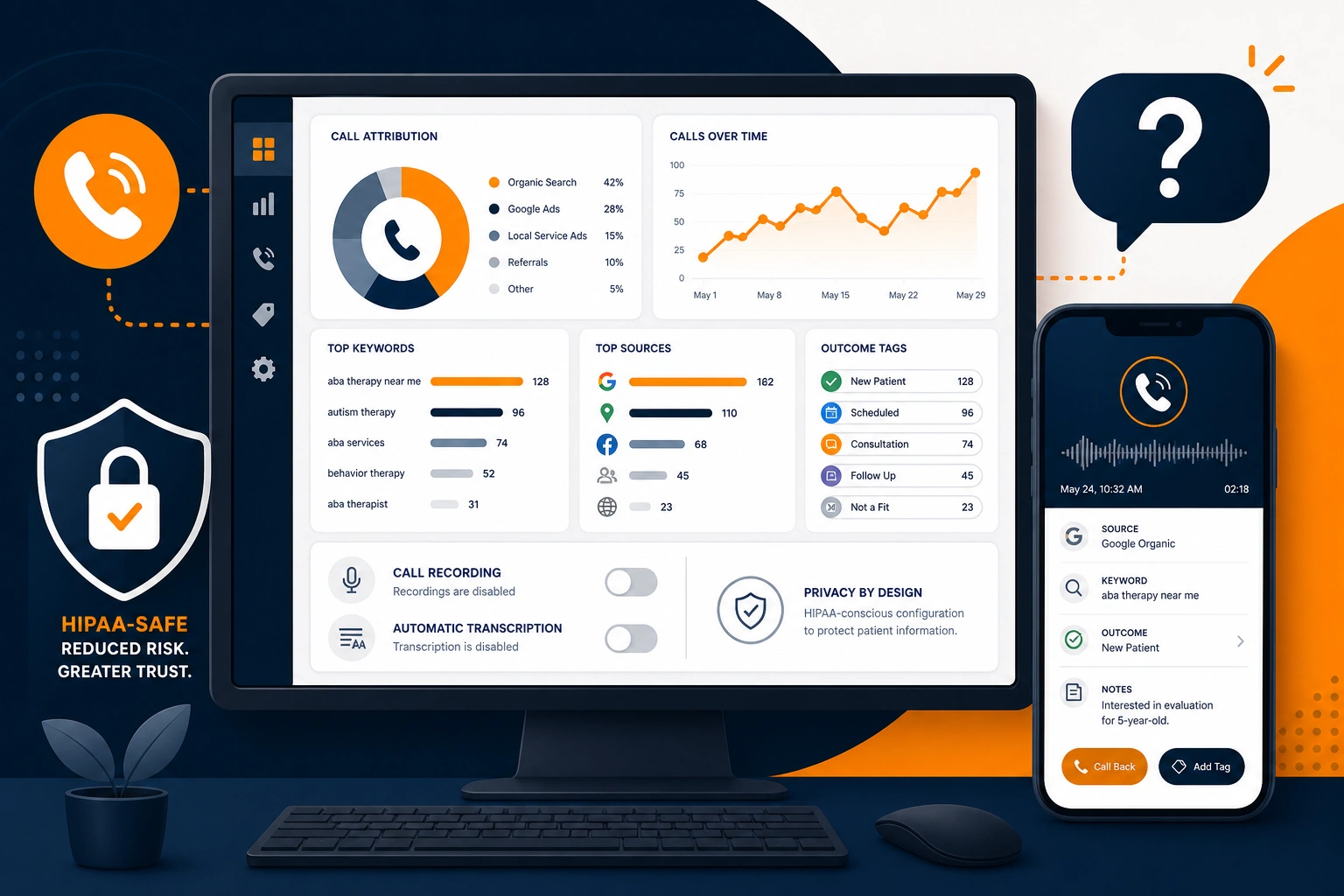
Call tracking looks like a pure marketing tool. For an ABA practice, it is also a compliance risk hiding in plain sight. The moment a parent picks up the phone and describes their child, the call can contain protected health information, and the software recording it may not be allowed to hold that data.
The goal is to keep the marketing value without the legal exposure. That means configuring the features that attribute leads and switching off the ones that capture sensitive detail. Regulators have already acted on healthcare tracking missteps, and the FTC’s enforcement record shows this is not a hypothetical worry.
Why Call Tracking Is a Compliance Risk, Not Just a Marketing Tool
Call data feels harmless until you look closely. A parent calling an ABA practice will often say their child’s name, describe behaviors, and mention a diagnosis, all within the first minute. That is protected health information, and it is now sitting inside your call-tracking platform.
If that platform is not authorized to handle PHI, you have a problem the marketing team never intended to create. The recording, the transcript, and even the metadata can all carry risk. Understanding where PHI enters the call is the first step to configuring around it.
What a Call Tracking Vendor Must Sign Before You Use It
The single most important requirement is a signed agreement. A call-tracking vendor that handles PHI must sign a business associate agreement, or BAA, before you send a single call through it. Without one, you are sharing protected data with a company that has no legal obligation to protect it.
The HHS sets out what these agreements must contain in its business associate guidance. Some vendors will sign readily and offer HIPAA-configured accounts. Others will not, and those are the ones to avoid entirely. No BAA means no calls, no matter how good the reporting looks. Ask the question before you buy, not after a breach.
Features to Configure: Attribution Without Exposure
Plenty of call tracking is perfectly safe, because it never touches PHI. Dynamic number insertion tells you which campaign drove a call without recording anything a parent says. Source and keyword attribution do the same. Outcome tagging lets your team mark a call as a booked intake or a wrong number.
These features give you the marketing insight you actually need: which channels produce calls, and which calls become clients. Configure them fully. None of them requires capturing the content of the conversation, which is exactly why they are the safe core of a compliant setup.
Features to Switch Off: Recording, Transcription, Storage
The risky features are the ones that capture what is said. Call recording, automatic transcription, and long-term audio storage are where PHI accumulates, and they are the first things to switch off unless you have a BAA and a clear reason to keep them.
You rarely need the audio to run good marketing. Disposition tagging, where a staff member records the outcome without keeping the recording, captures the useful signal and discards the sensitive content. If a vendor’s own HIPAA configuration options let you disable recording and transcription, use them. Keep the attribution, drop the audio.
Consent and State Recording Laws
If you do record, a second rulebook applies. Many states require all-party consent before a call can be recorded, which means an announcement at the start of the call is not optional. Ignoring this adds a legal problem on top of the HIPAA one.
The rules vary by state, and legal references on two-party consent laws show how much they differ. Before enabling any recording, confirm your state’s requirement and build the consent announcement in. When in doubt, the simplest compliant path is not to record at all.
A Compliant Call Tracking Setup, Summarised
The compliant version is easy to state. Sign a BAA, configure attribution and outcome tagging, switch off recording and transcription, and confirm your state’s consent rules before enabling anything that captures audio. That setup gives you the marketing data and none of the exposure.
Call tracking done this way is an asset, not a liability. For how it fits alongside your analytics and the rest of your measurement, our HIPAA-compliant marketing resource ties it together. Track the source of every call. Just never the secrets inside it.
Frequently Asked Questions
Is call tracking HIPAA compliant?
It can be, but only with the right setup. You need a signed BAA with the vendor, attribution features enabled, and recording and transcription switched off unless you have a specific compliant reason to keep them.
Can ABA practices record phone calls?
Only with care. You need a BAA covering the recordings and must follow your state’s consent law, which in many states means announcing the recording to all parties. When in doubt, do not record.
What call tracking features are safe to use?
The ones that never capture what is said. Dynamic number insertion, source and keyword attribution, and outcome tagging give you full marketing insight without storing protected health information.
Supporting deliverables
AI image generation prompt: “Flat-vector illustration of a phone-call icon passing through a shield with two toggle switches, one green on for attribution and one red off for recording, calm blue and slate palette, clean compliance aesthetic, no readable text, 16:9.”
Image alt text: Call tracking HIPAA setup showing which features to configure and which recording features to switch off.
Meta description: Call tracking HIPAA guidance for ABA practices: which features to configure, which to switch off, and how to stay compliant on call recording.