
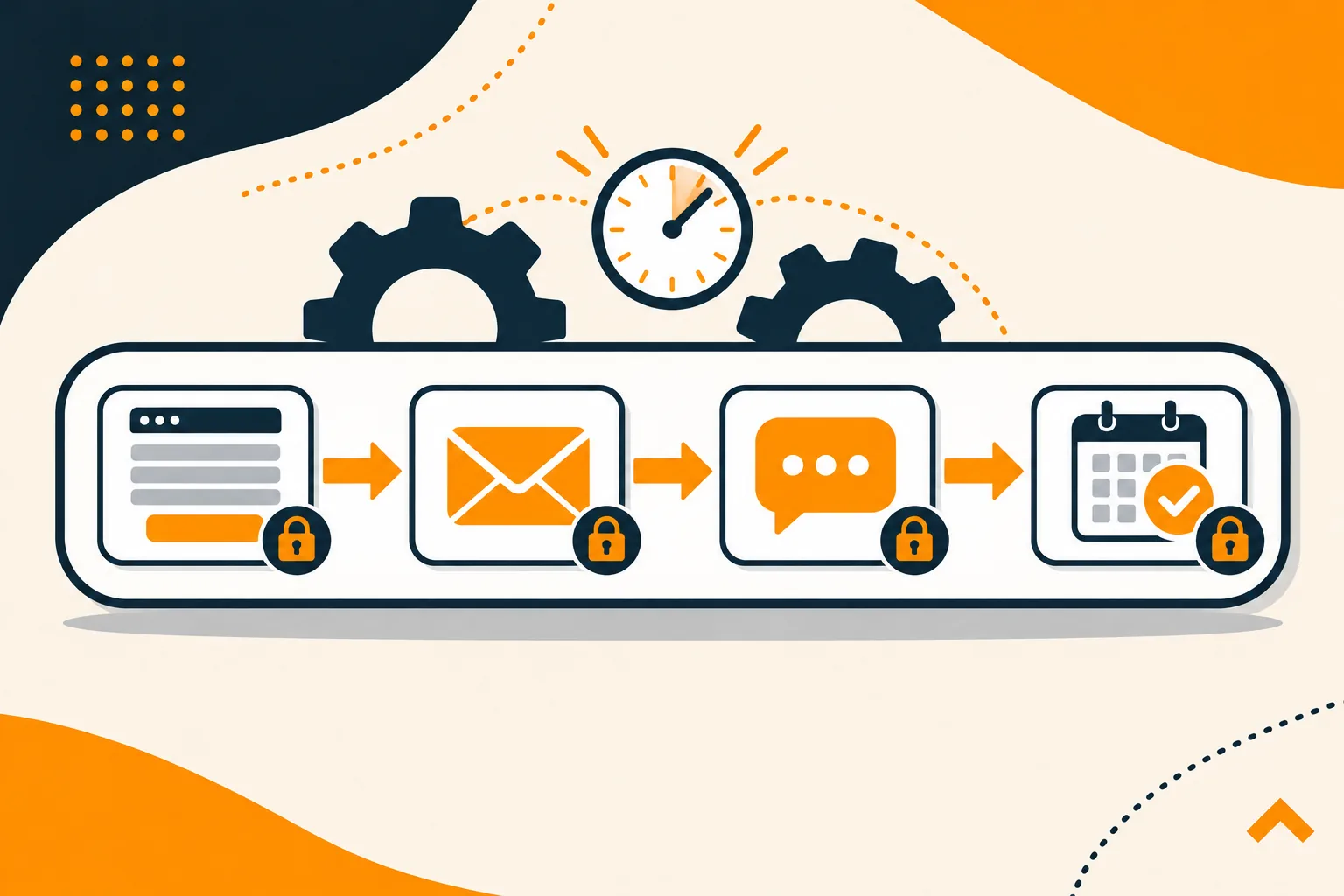
A parent fills out your inquiry form at 9:40 p.m. and, within seconds, gets a text: “Thanks for reaching out about Liam’s autism evaluation! We’ll call tomorrow.” It’s fast and friendly, which is exactly what families want. But the SMS tool behind it never signed a business associate agreement. And the message named a child and a diagnosis.
The speed was right. The setup wasn’t. HIPAA compliant marketing automation keeps that instant response while removing the exposure, and it depends on building things in the right order.
This article is that build order for automated intake in ABA therapy. The parent is the person receiving these messages, but you’re the one running the system. So everything here is written for the owner or operations lead who has to make it fast and defensible at the same time.
What Makes Marketing Automation HIPAA Compliant?
Marketing automation is HIPAA compliant when every vendor that creates, receives, stores or transmits protected health information (PHI) is under a business associate agreement (BAA). It also requires that each message shares only the minimum necessary information. A BAA is a contract in which the vendor commits to safeguarding PHI under HIPAA rules.
Many owners assume an inquiry form is just marketing data. It isn’t, once a covered provider captures a child’s name, age, diagnosis status or insurance details. At that point, the form submission is PHI, and every tool that touches it inherits the obligation.
Encrypting electronic PHI (ePHI) doesn’t get a vendor off the hook either. Per HHS guidance on cloud vendors and BAAs, any cloud service storing ePHI is a business associate, even with encrypted data and no key. No BAA means no PHI in that tool, full stop. HHS also describes an OCR resolution with a covered entity that stored ePHI for more than 3,000 people on a cloud server without one.
Which Tools in Your Intake Stack Need a BAA?
Any tool in your intake stack that touches PHI needs a BAA, and most clinics have more of those tools than they realize. The simplest audit is a two-column worksheet. List every system a parent’s inquiry passes through, then mark “Touches PHI?” and “BAA signed?” beside each one.
- Web form builder: the first place a child’s name and diagnosis status get captured.
- CRM: where the lead record lives, often with notes from every call.
- SMS provider: the platform sending automated texts, which is frequently a cheap add-on with no BAA.
- Email platform: newsletter tools are often not configured or contracted for PHI.
- Call tracking and recording: recorded intake calls can contain diagnosis and insurance details.
- Scheduling calendar: appointment titles like “Liam, autism eval” are PHI.
- Middleware connectors: Zapier-style tools that pass form data between systems.
That last item is the most common gap. A clinic might have BAAs with its CRM and its EHR, yet route every form submission through a connector on a standard plan. The data still moves through a third party, so the connector is part of the chain. And because these workflows are often built by whoever had a free afternoon, nobody checks the contract.
Consolidation is often the cleaner fix. Fewer tools means fewer BAAs to sign, track and renew. Reputation Elevation signs BAAs where required and offers Lead Center, a HIPAA-ready CRM with encrypted communications, access controls and automated follow-up sequences. You can read more about our approach to HIPAA-compliant marketing and automation for ABA practices.
What Should Automated Follow-Ups Say, and What Should They Leave Out?
Automated follow-ups should confirm receipt and name the next step, while leaving out the child’s name, diagnosis and insurance payer. That’s the minimum necessary standard in practice, and a good first text reads: “Thanks for contacting us! A coordinator will call from this number within the hour.” Nothing in it reveals why the family reached out. That matters on a shared family phone or a lock screen anyone can read.
Email works similarly. In its FAQ on emailing patients, HHS says providers may use email with reasonable safeguards, such as checking addresses before sending. If a family starts the conversation by email, providers can generally reply that way. You may also warn them that unencrypted email carries some risk.
Documents are a separate problem. Intake packets, insurance card photos and diagnostic reports should travel through a secure portal link, never as email attachments. The automation can send the link, but the sensitive file should stay behind a login.
Here’s a sample three-touch sequence for automated intake in ABA therapy, with the copy kept generic on purpose. The first touch is an instant text confirming receipt and promising a call. The second is an email two hours later with your clinic’s phone number, hours and a secure portal link for the intake packet.
The third touch isn’t a message at all. It’s a call task assigned to a coordinator for the next morning, in case the family hasn’t picked up yet. A real voice on the phone often lands better than a third automated nudge. For broader campaigns beyond intake, see our guide to running email campaigns without HIPAA risk.
How Do SMS Consent Rules Fit Alongside HIPAA?
SMS consent rules sit alongside HIPAA as a separate legal test, so a fully HIPAA-safe text can still break the law. The Telephone Consumer Protection Act (TCPA), enforced by the Federal Communications Commission (FCC), governs consent to automated texts. It applies whatever your HIPAA status.
The rules on revoking consent tightened recently. Under the FCC’s 2024 consent revocation order, replies such as “stop,” “quit,” “cancel” or “unsubscribe” revoke consent. You may send one confirmation text within five minutes, and it can’t contain marketing content.
Other provisions have moved around. The requirement to honor opt-outs within 10 business days, and the “revoke all” rules, have been delayed and revised, most recently in September 2026. As of November 2026, confirm their current status with counsel before you rely on any specific deadline.
The practical step is simple. Add a separate, unchecked SMS consent box to your inquiry form, with plain wording about automated texts. Don’t bundle it into a general privacy checkbox. Store the consent record, with a timestamp, in your CRM so you can show when and how each family agreed.
How Do You Track Intake Conversions Without Leaking PHI?
You track intake conversions safely by keeping identities in your CRM and sending ad platforms only de-identified conversion events. That’s the core of secure lead tracking for ABA practices. The rules behind it come from HHS’s bulletin on online tracking technologies.
The bulletin says tracking tools on logged-in pages, such as patient portals and scheduling, generally access PHI. Any vendor handling that data needs a BAA. Most tracking pixels from ad platforms don’t come with one. That’s why a Meta or Google pixel on your intake scheduler deserves a hard look before your next campaign launches.
Be precise about the court ruling here. On June 20, 2024, in AHA v. Becerra, a Texas federal court vacated the bulletin only where it treated certain unauthenticated page visits as PHI. That ruling didn’t make tracking unrestricted, and the rest of the guidance still applies.
So the safer pattern is a split. Your CRM holds the family’s details, and your ad platform receives a simple “qualified lead” event with no name, diagnosis or form contents. For the analytics side, see our guide on tracking ABA leads without putting PHI in Google Analytics.
Frequently Asked Questions
Can ABA clinics text parents about intake under HIPAA?
Yes, ABA clinics can text parents about intake when three conditions are met. The SMS vendor must be covered by a signed BAA. The message content should stay minimal, with no child’s name, diagnosis or insurance details. And you need valid TCPA consent for automated texts, ideally captured through a separate checkbox on your inquiry form.
Is Zapier or a similar connector HIPAA compliant?
Only if the specific vendor and plan you use will sign a BAA. Many connectors offer BAAs solely on enterprise tiers, if at all. Check the vendor’s current terms before routing any form data through it. If no BAA is available, keep PHI out of that connector entirely and use a covered integration instead.
Does a BAA make a tool compliant on its own?
No. A BAA is a legal requirement, but it doesn’t configure the tool for you. Access controls, user permissions, audit logs and message content still determine whether your setup protects PHI. A properly contracted SMS platform can still send a non-compliant text if the template names a child’s diagnosis.
What Is the Right Build Order for HIPAA Compliant Marketing Automation?
The right build order for HIPAA compliant marketing automation is straightforward. Map your vendors, sign the BAAs, write minimal messages, capture SMS consent, and only then connect tracking. Skipping ahead is how the 9:40 p.m. text happens. Done in sequence, you keep the speed families expect without handing their details to tools you haven’t vetted.
This is general information rather than legal advice, so confirm specifics with healthcare counsel. When you’re ready for a second look, schedule an intake stack review with our team.